Merken magazine
The Politics of Sign Language: Censorship, Oppression, and Indigenous Deaf Communities in North Africa
Discover the colonial suppression of North African sign languages, and the untold stories hidden in their gestures.
AFRICAHISTORY
Ines Cherifi · Edited by Merken Magazine
11/26/20254 min read
Language is certainly the heart of culture, but what does this represent in Africa, the continent with the highest amount of deafness and mutism? What place does language occupy for over 40 million people?
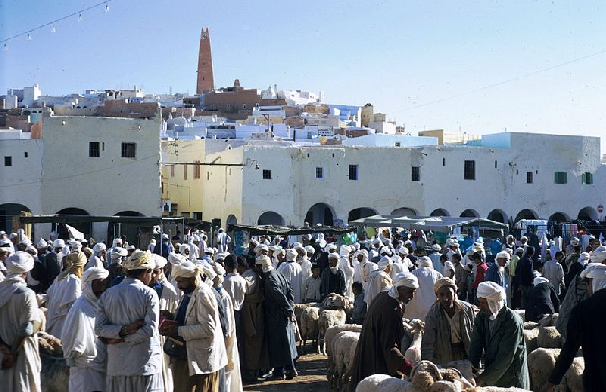
In traditional Indigenous North African societies, sign language developed organically. Gestural systems spread in markets, villages, and among tradespeople. Take for instance, the Ghardaïa Sign Language in Algeria (or the AJSL (Algerian Jewish Sign Language)). Certainly, a significant case study regarding the Jewish community in Algeria. The Ghardaia Sign language is a jewel of cultural novation, inclusivity and functionality in its given conjuncture; attesting that native sign languages are efficient and fully functional in their adaptability to the societies they emerged in. The Ghardaia Sign language is testimony to both the hybridity and versatility of language--allowing minority inclusion and expressional mastery amongst all Algerian communities who got in touch with the AJSL.
Nevertheless, the lack of post-colonial research on sign language in North Africa demonstrates an overall linguistic blockage: a continued unwillingness to broaden linguistic approaches and look beyond spoken language as the sole legitimate medium. Ultimately, this article will seek the complete redefinition of what language means, and who it truly speaks for.
The History of Sign Languages in North Africa: Indigenous Traditions, Colonial Influences, and Imported Standards
During French colonisation of Algeria (1830–1962), Tunisia (1881–1956), and Morocco (1912–1956), schools for Deaf children were built following French pedagogical ideology, which led to the massive importation of the LSF, the French Sign Language vocabulary. In Algeria, for instance, the colonial heritage of linguistics was even heavier, with traces of the LSF, to this day, as the only legitimate tool of expression for deaf communities.
This importation followed a pre-existing colonial viewpoint as colonisers always believed that indigenous communities were incapable of producing linguistic wealth. By framing the LSF as the legitimate means of deaf expression, colonial authorities not only erased local sign languages but also positioned French as the arbiter of educational and communicative authority.
Moreover, the complete erasure and subordination of Deaf communities in North Africa to colonial sign language reflects yet another colonial mechanism: determining who has the right of expression. Censorship was never total; colonial forces always strategically selected the few voices that were allowed to be elevated. Hence, privileging institutional mastery of French and Arabic while marginalising all other forms of expression, whether rhythmic, corporal or gestural. Rather than complete censorship, North Africa witnessed an even more dizzying reality: some voices were instrumentalised loudly, whereas others were removed from the very potentiality of expression. For all deaf communities, this was a censorship of silence itself.
Intersectional Oppression: When Factors of Marginalisation Multiply
What the state of sign language in North Africa reveals is that beyond the traditional oppressive relationship between the coloniser on the indigenous’ way of expression lie multiple, intersecting layers of oppression among the oppressed themselves.
Within the cleavage oppressor-oppressed, we can observe the dense internal hierarchies of marginalisation. The hierarchies appear most notably among minorities within the oppressed, such as people with disabilities and, within this group, disabled women.
“Deaf women face a double marginalisation for being both women and members of the deaf community”, highlighted Nadia Lazraq, the president of the National Federation for the Deaf in Morocco. Indeed, when marginalisation factors combine, they do not merely add up, they multiply. Acknowledging the already arduous access to education, healthcare, and institutions, deafness only escalates the alienation felt by North African women.
Revitalising Cultural Identity through Silence: Deaf Communities as Cultural Agents
As stated initially, we often consider language to be the heart of cultural identity. Freeing the tongue goes hand in hand with freeing gestures, bodies, movements, and eventually, sign language itself.
What is necessary, then, is the reclamation of language in all its forms as a cultural motor. Not predominantly orally or sonorous, but language as an inclusive, genuine and free expression.
The condition of North African deaf communities is a state that rises above regular concern. It reflects the reality of individuals who face daily alienation and expressive dissociation. The lack of sociological research and affirming care is a collective responsibility that falls upon all of us. The cost of this structural neglect is one we already pay for: the loss of all the potential cultural depth that authentic sign language could bring to the North African linguistic universe.
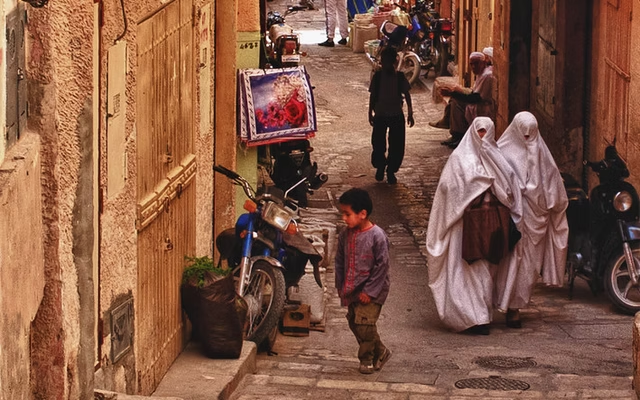
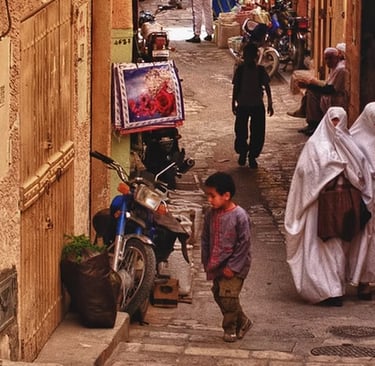
Ghardaïa, Algeria. Home to the native Ghardaïa sign language.
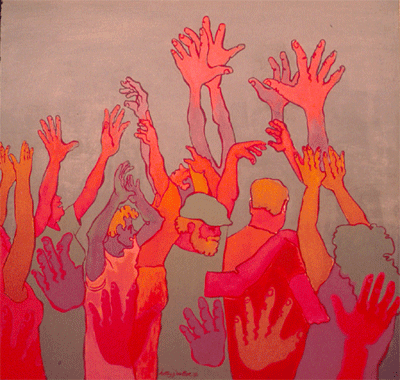
Betty G. Miller, “Celebration of Hands”
Ghardaïa, Algeria. Home to the native Ghardaïa sign language.
About the Author
Ines Cherifi is an emerging Moroccan writer and essayist, currently studying social and political sciences. Beyond essay-writing, she is deeply drawn to the humanities: exploring art criticism, prose, and creative writing through her platform sensu4lpolitics (available on Instagram and Medium, links bellow). It is a key motor in her work to essentialize and centre her creative productions on the North African region. Engaging with a field that remains largely underdeveloped, she hopes to fuel social, cultural, and innovative artistic perspectives rooted in the region.